If you wander through the islands of the Maldives, you’ll notice something unusual about some of the walls that line narrow lanes or surround quiet family courtyards. Look closely and you’ll see tiny pores, soft curves and patterns that carry traces of the sea. These are coral stones — once the lifeblood of Maldivian building traditions, and still resting quietly in the foundations of homes, mosques and memories across the archipelago.
Long before concrete mixers and imported bricks arrived on Maldivian shores, island builders turned to the material that surrounded them: the living reefs. Massive hirigaa coral was plentiful, close by, and surprisingly workable, although the work itself was burdensome. Freshly cut, the coral was broken down and chipped using simple hand tools. Once left to dry, it became firm and resilient, ready to stand for decades — sometimes centuries.
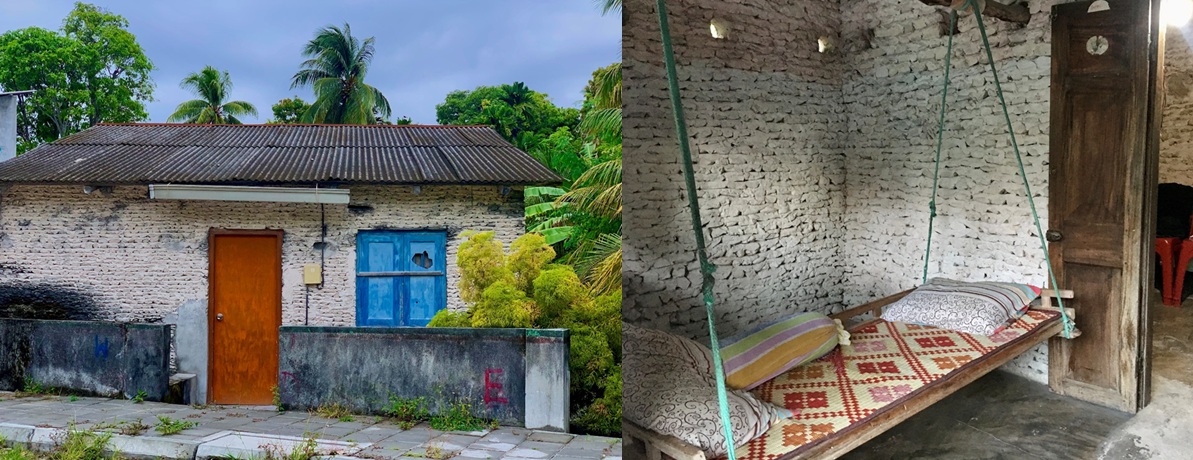
While coral stone is often remembered through the grand beauty of the Malé Friday Mosque and other historic religious buildings, it also formed the backbone of everyday life. Many traditional island homes, known as “Ge’”, rose from carefully stacked coral blocks. These houses were simple but graceful — one storey high, with tin or red-tiled roofs, and courtyards where children played, fish dried, and families gathered in the cool evening breeze.
Coral walls kept these homes naturally cool. Their porous structure allowed heat to escape, making them perfectly suited to the tropical climate. Builders fitted each block with remarkable precision, often using interlocking joints instead of heavy mortar. Their craftsmanship turned humble coral into sturdy, breathing walls that held warmth, laughter and family history.
The journey of a coral block from the reef to a home was anything but simple. Divers knew where to find strong coral heads, and boatmen helped bring the heavy pieces ashore. The work was demanding but done with a careful respect for the sea that provided the stone.
On the beach, craftsmen chipped, shaped and smoothed each block by hand. Their skills were passed down through generations — techniques for carving, fitting and creating patterns that transformed plain stone into something almost artistic. What seems like simple masonry today was once an intricate, deeply specialized craft.
By the 1990s, coral quarrying was no longer feasible nor responsible. As awareness grew about the fragility of the reefs, laws and community practices shifted to protect them. Modern materials — concrete, imported stone, prefabricated walls — gradually took over. Only in a few carefully managed places, such as heritage sites or select resorts, does recycled coral stone find its way into decorative features.
Yet even as new buildings rise across the atolls, the old coral walls remain, weathered but dignified. Many need care, their once-precise edges softened by salt spray and time. Conservators now work to record and protect what they can, knowing that the skills of coral carving and interlocking masonry are becoming rare.
Even now, in the quiet corners of older islands, you can find homes that still carry traces of this coral-stone tradition. Some retain full walls; others keep only their foundations. These structures stand like soft-spoken storytellers, offering glimpses into how earlier generations lived, built and adapted to the rhythm of the sea.
The coral may no longer be cut, but its legacy lives quietly on, etched into the stones that still watch over old island paths.