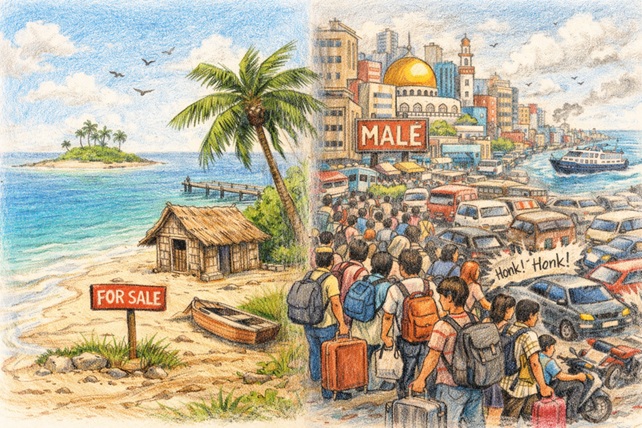
Malé at Breaking Point
a
Admin
March 7, 2026 · 5 min read
By concentrating opportunity on a sliver of land, the Maldives has turned its capital into both a magnet and a pressure cooker.
For generations, Malé was not just the capital of the Maldives—it was a community. Land was scarce even then, but belonging was clear. If you were born there, or your family had long roots in the island, you belonged, and land was allocated accordingly. That social logic made sense in a small, slow-growing town. At least until available space ran out.
Today, Malé and its newly reclaimed and built extension of Hulhumale’, known collectively as “Greater Male’”, is a hyper-dense urban core carrying the political, economic, educational, and medical weight of an entire nation spread across nearly 1,200 islands. The old rules of land and belonging have collided with a modern reality—and the impact is becoming impossible to ignore.
A city pulled inward
Migration from the outer atolls to Malé was initially not driven by preference but by necessity. Jobs, higher education, specialist healthcare, state institutions, and political power was and still is, all concentrated in the capital. For many people from the outer atoll communities, moving to Malé was less a choice than a requirement for advancement or even basic security.
Today migration to Greater Male’ is exacerbated by the promise of social housing, newly reclaimed land plots all through a manipulative system of political patronage.
The result is a paradox: while Malé and its surroundings - Hulhumale’, Vilimalé and other reclaimed areas ultimately strain under congestion, overcrowding, and declining quality of life, many outer islands slowly empty out. Schools shrink, services degrade, and the cycle reinforces itself.
When housing solutions create new pressures
Government-led land reclamation and social housing schemes were meant to ease Malé’s housing crisis. Instead, they intensified. Newly reclaimed land as annexation to the capital promised relief, but they also sent a powerful signal: the future is still here.
Each new housing project increases expectations, fuels migration, and deepens competition for space. Demand rises faster than supply, and the government continues to justify further consolidation to meet this induced demand.
What was once a question of housing is now a question of entitlement and a vicious tool for voter manipulation.
Locals, migrants, and the politics of belonging
At the heart of growing tension lies a clash of moral claims. Long-term Malé residents argue that their historical attachment, sacrifices, and endurance through decades of overcrowding entitle them to priority.
Newer residents—many born and raised in the capital themselves—argue that citizenship, need, and contribution should matter more than ancestry.
Both arguments carry emotional weight. Neither can be fully satisfied in a land where space is effectively running out. Once an urban crisis becomes permanent, it is extraordinarily difficult to reverse.
A quiet generational crisis
Lost in the Male’-versus-RT (the atoll communities) debate is a deeper injustice: the generational one.
Housing in Malé is increasingly inherited, not accessed. Those whose parents or grandparents secured land or flats decades ago are insulated; those without such inheritance—regardless of birthplace—face lifelong insecurity.
Young people delay independence, crowd into shared apartments, or leave the country altogether.
Malé risks becoming a closed city, where opportunity depends less on effort or need and more on timing of birth or political affiliation. That is a dangerous foundation for social cohesion.
Politics under pressure
Scarcity turns housing into political currency. Promises of flats or land win votes; ambiguity over entitlement preserves leverage. As pressure increases, the temptation to divide—locals versus outsiders, deserving versus undeserving—grows stronger.
At the same time, national politics becomes capital centric. Outer islands lose voice, while Malé’s problems dominate policy attention. The country drifts away from a shared national vision toward a zero-sum struggle over a few square kilometres.
Where this road may lead
If current trends continue unchecked, the future looks fragile:
• Chronic housing shortages become permanent
• Social divisions harden along lines of belonging
• Young people disengage or leave
• Emergency, crisis-driven decisions replace long-term planning
At some point, in the not-too-distant future, the question might no longer be who deserves land in the Malé area, but whether Maldives can exist as an archipelagic sovereign state at all.
A choice still remains
The crisis facing Malé is the outcome of structural choices: centralizing opportunity, expanding housing without decentralizing life, and trying to govern an archipelagic country as a one-island country.
The future of the Maldives depends on a difficult but necessary shift: seeing housing as social infrastructure, not privilege; treating the capital area as a finite urban system; and making life in the atoll communities not a compromise, but a real, viable, attractive alternative for Maldivians.
A nation comprising a thousand islands cannot afford to place all its hopes—and all its people—on just one island.
Tags
Recent Posts
ޖަމާޢަތުގެ އިޤްތިސާދީ ތަރައްޤީއަށް މަގުދައްކައިދޭ ފޮތުގެ ޑިޖ...
Jul 27, 2026 · 1 min read
Small Gardens. Stronger Islands..
Jul 27, 2026 · 3 min read
What Really Built the Maldives?
May 26, 2026 · 6 min read
Midhili - The Tropical Almond Trees of Maldives
Feb 3, 2026 · 6 min read
Hirimaradhoo: An Island being Evacuated
Jan 1, 2026 · 5 min read